

In today’s digital world, that can’t get enough of automation, it’s the AI writers who are crowning the marketing charts. Here’s the dirty little secret: the more we let the algorithms dictate our words, the more we lose that all-important human element that will make our copy resonate. Sure, it sounds seductive: crank out words at breakneck speeds, no coffee breaks, no writer’s block. But hey, that shiny promise hides a mountain of risks.
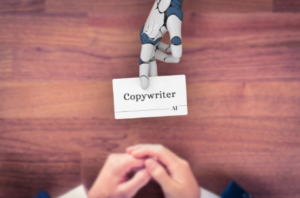
Image Courtesy: www.shutterstock.com
And while I’m certainly not here to tell you that AI isn’t impressive, whipping out emails or, product descriptions or social media posts in seconds is nothing special. But when it comes to more than that: crafting copy that cuts deep, moves emotion, and then prompts action, it’s a fast lane to mediocrity with AI.
Let me provide some reasons why you should never trust AI with your words. By doing so, you might be committing the most expensive mistake in business.
No Emotional Intelligence
Great copy is not just some words strung together. It’s all about emotion. It’s about knowing what are the pain points of your audience and which button to press on and at what time. AI doesn’t know how to do that. It can but mimic patterns it has been trained on, but it doesn’t feel. It doesn’t even know what it feels to be frustrated, excited, heartbroken, or desperate for a solution.
Just imagine the last piece of copy you read that moved you. Was it for just facts laid out or because it touched your heart? That is what makes good copy different from AI-generated content. AI lacks the pulse, intuition, and insight that makes writing sing. Copywriting is more art than science, requiring a soul in the making of each piece.
Human vs. AI Emotion: A Comparison
| DIMENSION | HUMAN COPYWRITING | AI COPYWRITING |
| Emotional Depth | Deep understanding of human emotions | Superficial mimicry of emotional tone |
| Empathy and Intuition | Understands subtle nuances of human experience | Can’t grasp the real depth of human feelings |
| It acts what it learned with instant feedback from customers | Continues to loop the patterns that is learned. | |
| Conclusion: Creativity Killed by the Algorithm | ||
Artificial intelligence is a one-dimensional space, like playing the piano with half the keys. It can play the notes, but nobody ever writes a symphony.
Creativity comes alive with nuances, serendipity, and even pure randomness. That’s why the great copywriters get those moments of unsuspected inspiration that turn the campaign from good to great. AI? Can’t color outside the lines. It is programmed to stick to the rules, and true creativity can’t thrive in a system built on ensuing patterns.
How long ago was it, do you think, that the last lightbulb moment you had about something by doing an algorithm? Exactly. AI can’t think outside the box. It won’t leap over the sea of samey-same content for you.
Creativity: AI vs. Human Comparison
| DIMENSION | HUMAN COPYWRITING | AI COPYWRITING |
| Innovation Generation | Novelly, often triggered by serendipitous thought | Of a pre-existing pattern and data |
| Agility | Turns on a dime, changes course on the wing | Stuck with pre-determined outputs |
| New Innovative Capability | Inputs new, innovative ideas | Utilizes pre-designed templates |
The Validity Problem
Also, the problem is that AI does not have a voice. That indelible sound created by you, the soul of the business. That unique brand voice that separates the man from the boys just cannot be mass-produced by an algorithm. At best, it can do what you want- watered down. At worst, you sound the same as everyone else.
Authenticity lies at the heart of any real marketing campaign. Customers can get the smell of fake from a mile away. They care to know who stands behind the brand and wants to connect to real human experiences. There’s just no way AI can ever give that. No matter how advanced it gets, it will always miss the personal touch, the quirk, the idiosyncrasies that make your brand, well, you.
Imagine AI as a template. It gives you that first draft that feels “good enough,” but it’ll never give you something that feels human. And in a marketplace filled with generic content, good enough isn’t good enough anymore.
Trust Issues: AI Copywriting Can Destroy Credibility
Imagine that everything you are leaving in the hand of an AI writer as an important message to your customers; the end result is deaf on tone, irrelevant, or worse, factually wrong. AI writers fact check nothing. They do not care about your credibility and do not lose any sleep over your reputation. If you are not careful, you are likely to become proud of an end result that kills off your brand’s trustworthiness.
It captures information from the internet without filtering it for relevance or accuracy. That will lead to AI content holding outdated information, incorrect information, or sometimes both. It makes your business look uninformed or unprofessional.
Do you want to say something that you do not know is true? It takes years to build a brand, but seconds to destroy it. Credibility builds trust. AI does not have skin in the game. You do.
AI: The Cookie-Cutter Copy Machine
We have all seen it. That copy which feels eerily familiar, i.e., you’ve read it a hundred times before. It’s AI copy, designed to follow trends and not set them. The same tired phraseology and structures are spewed again and again. AI is a cookie-cutter copy machine.
It’s not really a problem if you are relying on AI; you’re creating something that cannot be original. You are just churning out words, but you are churning it out into the white noise of the internet. And to be honest, the world does not need more content for content’s sake. It needs bold ideas, fresh perspectives, and words that stick.
Consumers are getting too smart. They don’t want to listen to copy that is shoddy, mass-produced. Consumers need to feel that the message was carefully crafted for their benefit, not mass-produced. AI cannot deliver that level of individualization and uniqueness.
I can only say it a thousand times: your brand voice is everything. It defines your business and makes it stand out from all the rest. It’s what your customers know, trust, and keep coming back to.
One thing AI definitely lacks is personality. So, it’s not going to be funny or understand sarcasm, and certainly doesn’t know how far to push the envelope and when not to. No algorithm can replace your brand voice because that’s who you are as a business.
You’re putting your voice at risk when you outsource copywriting tasks to AI. Of course, you’d save some hours, but at what expense? You would then blend in with the sea of generic, unremarkable brands.
AI Does Not Grow with Your Business
Your business is constantly changing, and so is your copy. AI, however, is stuck in a time warp. It’s based upon historical data, therefore, it will forever be playing catch-up. It cannot read the writing on the wall as far as the direction of your industry is concerned or as far as evolving consumer behavior goes. It’s a follower rather than a leader.
A good copywriter keeps his head in front of the parade. They know as markets change, so can your messaging. AI? That’s about as reactionary as it gets. It can only tell you what happened yesterday, not what’s going to happen tomorrow.
If you’re going to be relevant, then you need a copy that changes and shifts as your business does. AI just can’t keep pace.
The Legal and Ethical Minefield
Let’s not forget the legal and ethical implications. AI really does content generation well, very well, and sometimes it even plagiarizes. Guess who’s liable if your AI writer cross-copies a little too much from someone else’s? That’s right: you.
AI siphons off the web, but it doesn’t know how to properly cite anything, nor does it know copyright law. It doesn’t know its fair use rights or intellectual property rights. That’s what you do. And if you are not careful, you and your AI writer will find yourselves in some kind of legal hot water over content “borrowed” from someone else.
There’s then the issue of ethics: do you actually want to base your marketing on something that just reproduces what’s been swimming about in somebody else’s head? Your audience deserves more than that. They deserve original, considered content, not something that’s been dug out of the collective unconscious of the net.
Bottom line: AI Cannot Replace the Human Touch
AI can bring to the fore only its value in the creative world, but it is a tool and not a replacement for human creativity. At some point, dependence on AI brings along with it some genuine and serious risks: loss of emotional depth, creativity stifling, lack of authenticity, damage to your credibility, and even lead to potential legal headaches.
True enough, great copywriting actually has more to do with connecting to your audience than with concepts and whatsoever. Know what they want, need, and fear, and then talk to them at the right place where something smacks of emotional chord strikes. Something which AI certainly cannot do.
So, before letting the reins be taken over by an algorithm, ask yourself, do you want to just be another faceless brand or something that shines above this mediocrity? This is for you.