

We are living in a time genuinely obsessed with technology. Whichever way any directive is turned to, AI is optimizing something, apps are managing our lives, and algorithms predict what we need before we can even think about it. Imagine a world wherein customer service was not driven by the support and assistance of technology.
Allow me to narrate a story about Mumbai, India’s Financial Capital. It just beats me when I hear narratives of service excellence of two of the most non-tech service providers almost to the whole of Mumbai; yes, I am talking about the dabbawals (food delivery people) and the dhobis (washermen).
Brimming with pulsating energy, Mumbai is a city where top-of-the-class tech startups go neck and neck against modern financial hubs. Choco-block traffic intermingles with towering skyscrapers to provide a backdrop for human service excellence sans AI, IT systems, and mobiles. Yet, the service models in Mumbai are something to be admired; they are human-centric, community-driven, and fiercely accurate. How does this city succeed with traditional, tech-less service?
Now, let’s understand the magic that’s actually happening in Mumbai as far as service excellence is concerned. And usually, that starts with the super dabbawalas.
Human-Powered Logistics Perfection: The Dabbawalas of Mumbai
Unsung heroes of the lunchtime economy, churning out over 200,000 home-cooked meals for workers scattered all over the city, day in and day out. And incredibly enough, this is done with almost flawless 99.99% efficiency. Clearly, none of this is powered by Google Maps or delivery drones but by a human network built upon trust, discipline, and sheer efficiency.
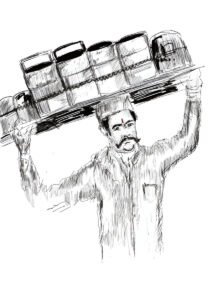
Image Source: https://www.shutterstock.com/image-illustration/illustration-dabbawala-1807960360
Could anyone even imagine such an extensive delivery network and not a single optimization through AI being performed? How would that even work in this fast world?
The Dabbawala System vs Modern Tech-Driven Delivery – A Comparison
| FACTOR | TECH-DRIVEN DELIVERY | DABBAWALA SYSTEM |
| DEPENDENCY ON TECHNOLOGY | Relay on GPS, algorithms, and apps heavily | No usage of technology at all |
| ACCURACY RATE | 92%-97%, frequent glitches | 99.99%, almost no human error |
| COST OF OPERATION | High since money is spent on the maintenance and overheads of technology | Cheap as it is human-powered |
| PERSONAL CONNECTION | Impersonal, via app notifications | Direct interaction and trust |
| SCALABILITY | Limited during system failures | Highly adaptable through human problem-solving |
What works is that the system of the dabbawalas is essentially founded on human precision and personal accountability. Every lunch box (“tiffin”) is a part of this very organized, non-digital method of exchange.
Everybody knows his job: each delivery man knows his job, and they communicate to others through an efficient coding system of colors and symbols; apps and texts have no place.
Can businesses around the world learn from the same, imbibing principles of human accountability and trust instead of finding technological fixes?
Dhobi Ghat: The Marvel of Human-Powered Laundry
Welcome to the ‘dhobi ghat’ or the world’s largest open-air laundry. Several thousand pieces of clothes are washed, ironed, and returned in a day, all by human hand—rows upon rows of clotheslines being pounded, scrubbed, and dried in the sun.

Image Source: https://www.shutterstock.com/image-photo/mumbai-india-january-18-2014-laborers-2249270629
These washermen of Mumbai, or rather its dhobis, attend to chores that even most advanced automated systems of laundries get baffled with. There’s no number to keep track of and no computerized inventory system, and yet seldom do clothes go lost, mismatched, or wrongly delivered. It is a finely tuned human-run system based on memory, routine, and trust.
Tech-Powered Laundry vs. Dhobi Ghat – A Comparison
| FACTOR | TECH-POWERED LAUNDRY | DHOBI GHAT |
| DEPENDENCY ON TECHNOLOGY | Sorting-automated, tracking inventory | No dependency on technology; human memory |
| ENVIRONMENTAL IMPACT | High energy and water usage | Low environmental footprint |
| COST | High operational and maintenance cost | Inexpensive, manual labor |
| TURNAROUND TIME | Varies with machine downtime or issues | Consistent, predictable turnaround |
| PERSONALIZATION | Standardized processes, no personalization | Personalized service for each customer |
The dhobi ghat stands today as a monument to human enterprise in the modern world of machines and automation. And each dhobi is proud of the work they do, which is basically the sense of personal responsibility that ensures things run like clockwork. Without using technology to be efficient, they depend upon experience and intuition.
What’s the Secret? Mumbai’s Formula for Success:
If there is one word that describes service excellence in essence within Mumbai, it is humanity. The power does not come via software or machinery in these systems but is harnessed through the strengths of human relationships and community networks.
Active Ingredients of Long-Lasting Success:
- Personal Accountability: This work executed by the dabbawalas or the dhobis is an identity, a prestige, and livelihood provider. This attachment to work automatically ensures an element of precision that no machine can provide.
- Community and Trust: Tracking numbers are not trusted; relationships are. A dabbawala or dhobi part of the community is hence implicitly trusted by his customers.
- Human Resilience: Technology is great until it breaks down. When systems go down, the machines malfunction or apps crash, human resilience sets in. The people behind such services are hardwired for quick thinking and problem-solving in a way technologies just cannot compete with.
What We Learn from Mumbai’s Service Models?
The natural temptation, of course, is how readily these examples are defined as no more than hangovers from pre-technological times. What if they were actually the future? When the companies across the world are automating, digitizing, innovating, there’s really something refreshing about going back to people-first ways.
It may be the theory, but where technology is more, the service provided would be much better, and Mumbai does not seem to follow this theory. But what if, instead of a purely tech-based solution, we could add a little human-type empathy and trust to our systems? It’s very important because the need here is for the human persona to instil feelings of trust.
Where Does Tech Fit into All This?
Should that mean we give up on AI, mobile technologies, and IT systems? Of course not. Technology has clearly revolutionized service in so many ways, and it shall continue to. But then, there does come a time when it is about time for balance. Technologies can iron out and automate but not replace the warmth, trust, and accountability implicit in human contact.
We could have a different future where technology extends human service rather than replaces it if we learn from Mumbai’s dabbawalas and dhobis. What if technology had been deployed to support human interaction rather than to alienate us from it? Consider systems aimed at enhancing, rather than replacing, human judgment. Does the term Augmented Intelligence ring a bell?
The Human Touch: Welcome to a Technology-Driven World
If one looks ahead to the future of customer service, the question becomes: can we learn from Mumbai’s tech-free service models? How will companies be adding more humanity to their line of processes?
The answer lies in blending technology and tradition. Mumbai’s dabbawalas and dhobis are not spurning technology; they thrive despite it. They proved that human accountability, trust, and adaptability are the only drivers of service excellence. It is here that the business entities across the board can take a leaf from them.
Wrapping Up: Service Excellence Without the Digital Crutch
Service excellence models remind us that technology, however much it benefits one, can never replace the human touch. In a fast-innovation-obsessed world, sometimes the most uncomplicated and human-driven systems set benchmarks for excellence.
Efficiency, precision, and trust are things that technology companies strive for but which the dabbawalas and dhobis of Mumbai seem to have perfected. All through them, something has taught us that service is not about automation; it’s about connective tissue-human beings showing up day in and day out with persistence, precision, and pride in their work.
Perhaps it’s time to reverse the way we talk about technology in service and adopt as motto that of the dabbawalas: “No excuses“. The difference amongst all three is simple: instead of AI, IT systems or mobile tech, we draw on those qualities that are going to continue to uniquely make us human: adaptability, accountability, and community-driven.
How do these dabbawalas work? Well, all that and more, in my next blog titled ‘Service Excellence Without Tech Support‘.