

Generative AI or GenAI- those words should evoke excitement and nervousness in us simultaneously. There appears to be a buzz of AI-generated content, data-driven insight, and automated creativity across businesses. It feels like it’s going to be long drawn, but what’s the pathway from buzz to implementation?
Quite the opposite, full of obstacles and steep learning curves, add to that these heaps of confusion.

Image Source: https://www.expert.ai/blog/adoption-challenges-of-genai-and-llms-in-insurance/
If you are one of those entrepreneurs and business leaders who look upon GenAI as a primary means to supercharge operations, big questions are always something you will have to face and wade through. How do you cut through the buzz and really drive value? Integrate without causing chaos? Train your teams without losing sleep or your sanity. To a great extent, by far.
To be frank, given the assassin that GenAI is, its adoption at most would be overwhelming. Of course, it is not impossible, as it goes with any monumental change. In this blog, we will talk about significant barriers standing between you and smooth sailing with GenAI—and how to conquer them professionally.
The Genesis of GenAI.
Setting the tone first about what is interesting of generative AI; in other words, in a nutshell, AI creates text, images, videos, and even code. GenAI is like having a creative partner available round-the-clock who is able to turn out high-quality work at command.
Areas where this may be useful include:
- Personalized marketing.
- Prediction design in products.
- Improved customer service.
- It even streamlines some HR processes.
Flashy, trendy and isn’t going anywhere.
A Big ‘But’: Upshots to Generative AI. For all its hype, adopting GenAI isn’t relatively as easy as thumbing a switch. As with any new technology that hits the market, very valid hurdles must be swamped before you’re ready to interact with this in your enterprise. Most of these challenges are attractive, having little to do with the technology per se but all to do with the people.
The following are some issues and solutions to cross those hurdles:
Feeding the AI Beast: Data Dilemmas.
Of course, the most important and obvious thing would be data: GenAI simply loves data and requires enormous amounts of it to learn and be tough at performing.
Good news? Most businesses have either very little data or the wrong type of data. The other headache is privacy and security concerns around using that data.
- Solution: Fundamentally, running an audit of the data you have at your disposal to know what you have and where the gaps are. Focus on what you feed the AI system with, in other words, quantity vs. quality. Data privacy is the billion-dollar question that has to be faced and squarely confronted, in full knowledge of the regulations like GDPR and CCPA, and in conformity with them. First, promise to keep the data secure. Then, create transparency with customers about how this data is put to work or how you would be using this data.
Who’s Running The Show? The Skill Gap.
The second major challenge is talent. Sure, AI is brilliant, but it doesn’t run itself.
You will need to have people knowledgeable in the training of models, the interpretation of outputs, and actually using such insights provided by AI. We just don’t have that many of these skilled AI professionals. Unless you’re one of the giants with a limitless budget, you might find it’s not that smooth and easy to actually hire or train the needed talent.
- Solution: First, reconsider upskilling, which in itself serves a couple of purposes. Yes, upskill the existing team with AI training, but let us get real here. People aren’t just about to wake up one morning and be experts in AI. It probably only makes tactful sense that one takes an interim step. Partner either with outside consultants in AI or think in terms of outsourcing specific parts of the process.
- It is going to be advisable to adopt low-code and no-code platforms at this juncture since the users can build applications and automate the business processes using visual interfaces with drag-and-drop features without writing any code. These tools are helpful for simplifying and speeding up the development process, hence reducing costs. You wouldn’t need a Ph.D. in Machine learning here.
Making GenAI Fit In Integration Nightmares.
Now that you have finally chosen that dream AI tool, you try installing it, and nope. Your systems are not compatible, API integrations are rife with bugs, and your workflows come to a grinding halt. Welcome to the wonderful world of integration problems. GenAI doesn’t exist in a vacuum, and one of the biggest obstacles to adoption can be getting it to ‘play nice’ with your current technology stack.
Everything from making certain it fits like a glove in your CRM or marketing software, while at the same time ensuring AI pulls the correct data out of your cloud servers.
- Solution: Well, it’s not impossible, but it might be a bit tricky. The key to this is perfect planning and everything implemented in phases. Start off small by integrating GenAI into one department of the business, in customer service or marketing, before deploying it company-wide. In that way, bugs can be managed piecemeal as opposed to the disruption of the whole. Invest in those secondary AI solutions that offer customization to meet the requirements of your organization, flexibility in APIs, and integrate seamlessly across multiple platforms.
Costs: Can You Afford the AI Revolution?
Let’s face it right off: AI does not come cheap. Once you start totaling the software licensing-implementation and acquiring talent costs, not to mention upkeep, it sometimes seems AI is a playground reserved only for the largest of companies. What if your business happens to be small- to mid-sized? First and foremost, what has to be understood here is that AI is not a one-time overbearing kind of cost but is actually a long-term investment.
First, narrow it down: demarcate areas where AI is going to make a difference. Example uses of GenAI in process automation at customer touch-points have the objective to free up more valuable human capital for value creation purposes and save money in that way.
Another one would be scalable AI solutions so you could grow with your business. Most include subscription-based pricing, with tiered service levels that make it even easier to launch from small and scale up without overinvestment in software licenses or hardware infrastructure.
Accountability in AI Creation: Moral Dilemmas.
From biased content to AI-splashing down to problematic outputs, the headlines take you right through deep fake videos. Going deep into the adoption of GenAI, you literally walk into an ethical hotbed.
What if your AI inadvertently kicks out something offensive or biased? Where does the responsibility lie? Okay, you can’t avoid this challenge, but you can definitely reduce it: Train your AI model using multifarious and inclusive data.
After all, bias in translates into bias out.
Strong human reviews of AI outputs before going live. Bake transparency into your AI strategy by communicating to the audience when and how AI has been used in your processes. When AI does something, own it.
Cultural Resistance: Getting A Nod from Your Team
People are creatures of habit. Now throw in something new and possibly disruptive, like AI, and you’re sure to face some resistance from your workforce. The general concern might be that it could take away their jobs or that they simply don’t want to learn a new system that seems pretty overwhelming.
- Solution: This is where communication and education take place. Take them through it, explaining how AI is not some sort of big evil monster but actually a tool to help them in their work. Position it as a way to automate grind work, freeing them up for more creative or high-value work. In fact, the adoption of AI should be with the members of the team itself as early as possible so that they take ownership of the change. All this makes them more inquisitive and participatory in the processes of learning and development. Be inclusive right from the very inception of the implementation process.
Implementing for the Future: Weeds and Other Ways of Overcoming the Buzz
The thing with generative AI is that it’s not just another trending technology; it is rather the complete disruption of how business can and will operate. And indeed, as such change, it is no wonder that multi-dimensional challenges are experienced. The scenario is not going to soon stand on the doorstep of the AI gravy train, awaiting an opportunity to board it. Effort implies preparation for applications.
The general adoption of GenAI is not smooth; the moment you have conquered one problem, another one rises. It is only then, when there is a clear-cut niche and a well-earmarked strategy that one can move to the buzz and go further with the phase-by-phase model in order to flourish.
It will therefore be aware of the challenges it will have to confront long before they actually arise and, with that awareness, ensure that in order to address those challenges with new solutions, it harnesses the AI revolution as an effort to unlock new efficiencies, effectiveness, and profitabilities.
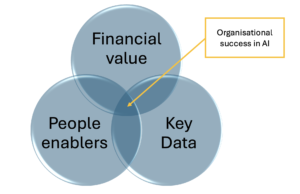
Image Source: https://www.weforum.org/agenda/2024/04/ceos-cfos-take-note-3-key-ways-to-adopt-genai-successfully/
Thus, ready to make the buzz live? For your enterprise’s future, it might just be the case.