
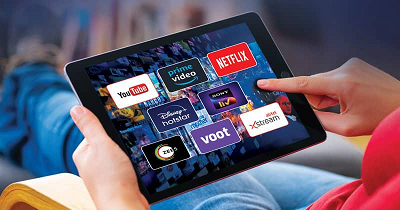
Not so long ago, we could only consume whatever we had on the few channels available to us. Then came an explosion of cable and gave hundreds of channels available at our fingertips.
Fast-forward to today—the digital age gave birth to OTT platforms. That really changed the game in terms of how content is consumed nowadays. But with every leap forward that technology takes, there is another side of the coin. While these provide endless entertainment, it is also in a position to influence the social and ethical mores in society to a great degree.
Image Source: https://solguruz.com/blog/ott-platforms-important-things-you-should-know/
Emergence of OTT Platforms
But first, setting the stage with a little context: OTT only refers to services whereby the stream goes straight to the viewer by use of the internet and bypasses the conventional cable or satellite TV services. Netflix, Amazon Prime Video, Hulu, Disney+, and others are the household names with their vast libraries offering films, series, documentaries, and original content.
But OTT platforms are more than amusement parks; they also double up as strong devices of influence. Unlike traditional media, which were pinned down by strict regulations and controls relating to the content, OTT platforms operate in a space far from inhibitions. This freedom has also enabled them to push the envelope, break conventions, and at times even redefine what is socially and ethically acceptable.
The Power of Shaping Social Norms: Content
It need not be said that media, in every form and hue, shapes the very values and ideals on which stand society. First, it was television and movies, and now OTT platforms have turned into mirrors to society’s ever-changing beliefs, behavior, and ideals. These mirrors reflect not only distantly but sometimes distortively, too.
Normalization of Taboo Subjects:
OTTS platforms have brought into discussion topics which earlier were treated as taboo. Netflix’s ’13 Reasons Why’ and the recently released HBO show ‘Euphoria’ have really dealt with sensitive issues like teen suicide, drug addiction, and mental health. The conversation that such a show has raised is hushed or swept under the carpet. This, on one side, brought awareness and understanding of the problems; on the flip side, it raised a number of concerns with the glorification of such topics and their influence on impressionable audiences.
Take, for example, the debate over ’13 Reasons Why’. While exposure to the show about suicide was a nucleus way of increasing awareness, some are concerned that, in so doing, the platform may actually encourage imitators among the most vulnerable teens. It begs the question, right there and then, where do we draw the line between raising awareness and glorification?
Aspect |
Positive Influence |
Negative Influence |
| Mental health awareness | More dialogue and understanding informally | The potential to glorify and imitate |
| Diverse representation | Increased inclusion of more types of people | Stereotyping and simplification |
Reinforcing Stereotypes:
Similarly, while OTT platforms have tried to promote diversity, they have also managed to reinforce, in some instances, extremely harmful stereotypes. The ideas being put forth would range from one-dimensional representations of certain ethnic groups or communities that are furthering stereotypes rather than helping dismantle them.
Let’s take only the representation of South Asians in Western media. As much as improvement has come about, most shows seem to return to tropes: the über-strict parent, the tech geek, and the subservient daughter. Whatever that would mean for the development of these characters aside, it propagates shallow images of whole communities.
Shaping Gender Identities and Relationships:
OTT platforms, too, are taking a strong stand against stereotypical gender roles. Serials like ‘The Marvelous Mrs. Maisel’ and ‘Fleabag’ have strong females with complexities that challenge societal expectations and make them strong, hence reflecting a change in the landscape of gender dynamics.
However, there are also some cons to this approach of empowerment. For instance, the depiction of relationships, particularly love relationships, by OTT platforms is singularly linked with a misjudged understanding of fiction and facts. Toxic love in a series on Netflix, for instance, may point to mixed messages on what behavior is acceptable in a union. It can be distorted further into views on healthy relationships by younger viewers.
A Double-Edged Sword:
Ethical Implications Essentially, while one cannot deny the social impact created by OTT platforms, they have surely raised an ethical debate in the current scenario. It has opened up the debate on content censorship versus creative freedom.
Probably, the most debated issues are content censorship and creative freedom. Traditional media usually have to work under the strict laws of censorship that define what is permitted to be shown and what is not. In this very case, OTT platforms are much easier to cope with. Probably, because of the relaxed regulatory environment, the possibility of creating something bold and boundary-pushing has been preserved more than would be achieved on traditional platforms.
But this freedom also comes with its share of responsibility. The OTT platforms have, of late, faced criticism for not doing enough to protect the vulnerable audience, especially children, from inappropriate content. Though parental controls do exist, how far they are effective is always in question. Besides, the volume of the content is so huge that no regulatory body can monitor everything that is dished out.
The Role of Algorithms in Shaping Values
The other ethical concerns relate to algorithms driving OTT. Algorithms designed to keep viewers hooked use recommendations based on previous viewing behavior. While as a form of approach, this certainly enhances user experience, sometimes it creates echo chambers whereby viewers are presented only with those streams of content that reinforce their prior views and values.
In such a way that if a viewer regularly watches criminal dramas, then the algorithms of the particular platform keep suggesting similar content. It may breed a perception in them that more and more crimes are being held around them when, actually, that may well not be the case. This does send some serious questions into motion about the OTTs themselves, and how they make sure their algorithms do not get linked to the inadvertent spread of misinformation or reinforcement of harmful ideologies.
Ethical Issue |
Traditional Media |
OTT Platforms |
| Censorship of Content | Strict regulations | More relaxed, leading to creative freedom |
| Algorithmic Influence | Limited personalized content | Highly personalized, possible echo chambers |
Shift in Cultural Terrain: Social Impact
Going beyond the level of individual value sets, OTT platforms have somehow marked a sea change in the broader cultural landscape.
Globalization of Content:
Globalization of content is arguably the most significant positive that has come along with OTT platforms. Shows and movies, produced now from across the world, are being made available to the rest of the world. This helps in the cross-pollination of cultures and ideas. That has expanded horizons since viewers get to be exposed to so many perspectives and ways of living.
Theoretically, this is a case of cultural exchange; most certainly, it is not an equal exchange. Global markets are filled with Western content that very often suppresses local productions. It also brings in loads of concern for cultural imperialism, wherein Western values and ideals are imposed on other cultures via media.
Erosion of Local Traditions:
For all that access to global content, the risk of erosion in local traditions and values too exists. The youth, particularly, may get attracted to these supposedly very attractive lifestyles glimpsed through repeated Western media images. This may result in the slow dilution of interest in one’s own culture and value system.
This is manifested, for instance, in the way Western media portray individualism and independence that is sure to have an impact on the so-called traditional concept of family in many non-Western cultures. Such value changes might have very far-reaching results for the social fabric of these societies.
Responsibility of OTT Platforms: Call to Action
A lot of responsibility lies with the OTT platforms to ensure that during sensitive times, they would look into the social and ethical implications. That does not mean that strict regulations operate on traditional media. Still, yes, they must be vigilant in taking concrete steps so as not to cause harm.
Encouraging Responsible Content Creation:
The OTT platforms should encourage and incentivize responsible and social content. This can be done by joining hands with the creators in bringing to life series and movies that deal with topical and critical social issues in a sensitive and considered manner.
Controls on Content Become Stringent:
While creative freedom is important, there is a need to ensure more stringent controls to protect vulnerable audiences through much stronger parental controls, more explicit warnings about the contents of a program, and increased transparency on the possible impact of some content.
Algorithmic Transparency and Accountability:
It’s time OTT platforms are more transparent with respect to how their algorithms work and take more steps in ensuring they are not unwittingly amplifying the worst content.
Future of OTT Platforms and their Societal Values
Without a doubt, the penetration of OTT platforms will finally go on to influence social and ethical values. Since this is a platform that is here to stay, inasmuch as they keep growing in popularity, it goes without saying that this influence upon society will rise. Though a powerful tool for positive change, OTT platforms bear a number of risks.
The balancing act ahead for the OTT platforms balances between creative freedom and social responsibility. Perhaps a future where entertainment and societal values coexist in harmony is in the making by proactive intervention in mitigating the ethical impact of content and algorithms.